Opening hours, closing days, and practical information
Opening hours, with no unpleasant surprises
The museum opens at 10:00 a.m. and closes at 6:00 p.m., six days a week. The only thing you really need to remember is Tuesday: that’s the closing day, and it’s precisely the day when many people show up at the door because most major Parisian museums close on Monday. I repeat this to every group I guide: Orsay closes on Monday, Moreau closes on Tuesday. If you’re planning an itinerary with the Paris Museum Pass, this little detail matters.
The galleries close a quarter of an hour before the official closing time. Since the studios are on the second and third floors and can only be reached by stairs, arriving after 5:00 p.m. leaves you too little time upstairs. I recommend entering no later than around 4:30 p.m. for a standard visit, the duration of which I explain in How long does the visit last?.
Annual closures
Just three dates: January 1, May 1, and December 25. For the rest of the year, including public holidays, the museum operates its usual hours, except on Tuesdays. On the first Sunday of the month, admission to the permanent collections is free: this is the busiest day for the house, which here means a few dozen people at most in the studios at the same time. Everything is explained on the page Is the museum free?.
The best time of day
Around 40,000 visitors a year—that’s what this museum receives. Spread over six opening days a week, this makes for a nearly always quiet house. Still, two moments are particularly worth considering. Opening at 10:00 a.m., because you’ll have the studios to yourself, and the morning light on the third-floor skylight is the same as the one Moreau worked in. And the late afternoon on weekdays, between 3:00 p.m. and 4:30 p.m., when the few groups have left. Saturday afternoons and the first Sunday of the month are the only times I’ve seen people on the spiral staircase.
Wednesday and Thursday mornings are my favourite days. I’ve never had to wait at the ticket desk, and I’ve often been alone in the first-floor apartment for a good ten minutes.
What you won’t find here
Best to say it before you arrive. There’s no café, no restaurant, no terrace: you can’t have lunch at the museum. Rue des Martyrs, just a few minutes away, takes care of that very well. There’s also no lift to reach the studios: this is an old house, with its stairs, and the famous spiral staircase connecting the two studios is steep. Visitors with mobility difficulties can see the ground floor, but the upper floors require good legs. There’s no audio guide either, and the labels are minimal; hence the importance of reading the page on works to see before you come.
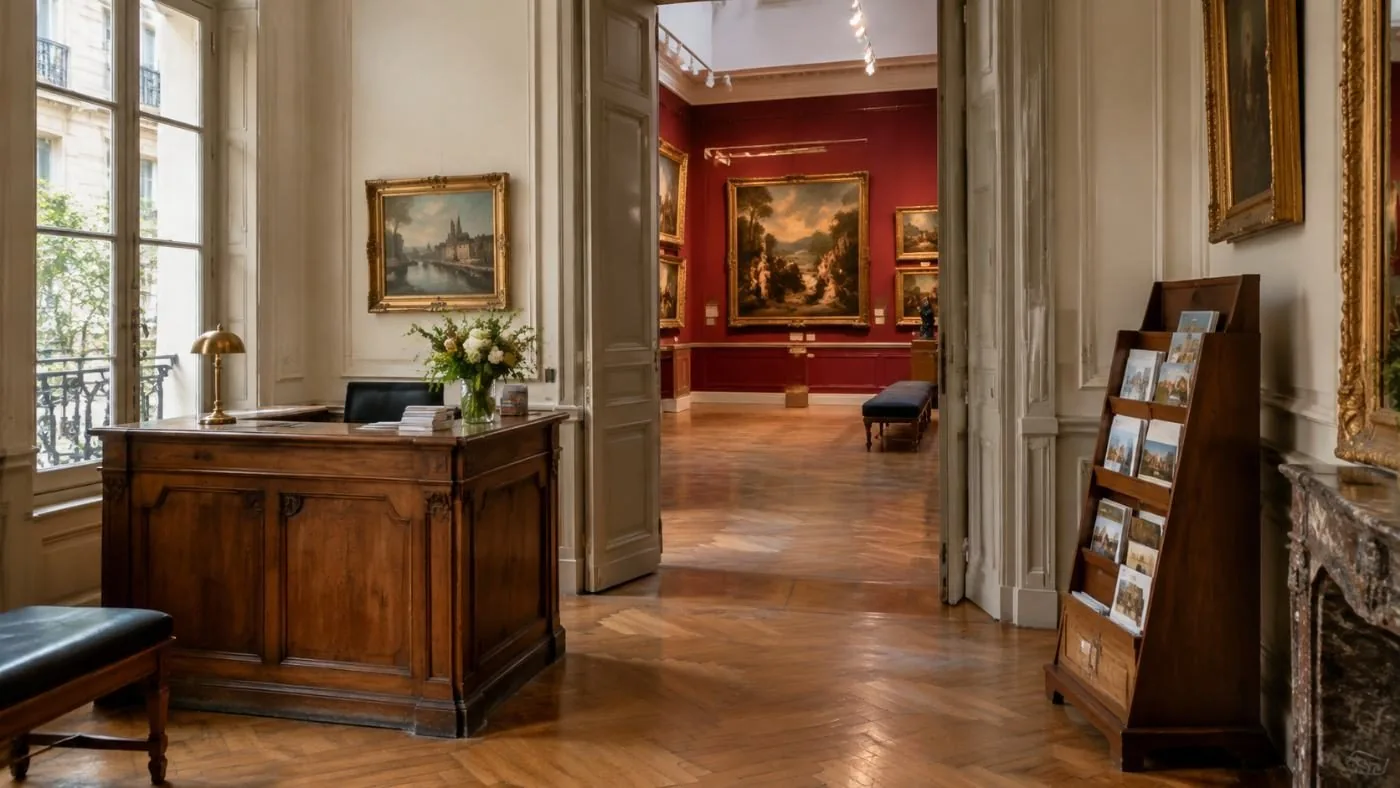
What you’ll find: a small bookshop at the entrance, well-stocked for catalogues, and a reception desk that willingly answers questions. Photos without flash are generally allowed in the galleries, and the staircase is probably the most photographed subject in the 9th arrondissement.
Tickets and booking
The museum does not sell timed entry slots. You simply arrive, buy your ticket at the counter or on the official website musee-moreau.fr, and enter. The ticket grants access to the first-floor apartment and the two studios, and it also entitles you to a reduced rate at five other venues, including the Musée d’Orsay and the Palais Garnier. Visitors under 18 and EU nationals aged 18–25 enter free of charge. Full details are on the tickets page. If you plan to visit several national museums in the same week, the museum is included in the Paris Museum Pass, and it is even one of its best-kept secrets.
Address and access
14 rue Catherine-de-La-Rochefoucauld, 75009 Paris. The street is short and quiet, halfway between the Église de la Trinité and Place Saint-Georges. Two stations on line 12 serve the museum at equal distance: Trinité–d’Estienne-d’Orves and Saint-Georges. Pigalle (lines 2 and 12) and Notre-Dame-de-Lorette (line 12) are a few minutes away, and several bus routes stop nearby. From Place de l’Opéra, allow about ten minutes on foot heading north. Detailed routes, including from the Musée d’Orsay and Montmartre, are on the How to get to the museum page.
Extending your day
A visit to the Musée Gustave Moreau rarely takes more than an hour and a half. This makes it an excellent complement: a morning here, an afternoon at the Palais Garnier or the Musée d’Orsay, where his large canvases are displayed. The Paris Museum Pass covers the museum and around sixty other venues; here are its availability options.
Frequently asked questions
Is the Musée Gustave Moreau open on Mondays?
Yes. The museum closes on Tuesdays, not Mondays. This is the opposite of the Musée d’Orsay and most major Parisian museums, making it a good option for a Monday. The full calendar is on the opening hours page.
What is the latest time to arrive?
The galleries close a quarter of an hour before 6:00 p.m. To see both studios and the apartment without rushing, I recommend entering before 4:30 p.m. The visit lasts about an hour to an hour and a half, as I explain on this page.
Do I need to book a time slot for the Musée Gustave Moreau?
No. The museum does not sell timed entry slots and is rarely crowded. You can buy your ticket at the counter or on musee-moreau.fr. The terms, free admission options, and the reduced combined rate with five other museums are detailed on the tickets page.
Is there a café or cloakroom at the museum?
There is no café. For lunch, rue des Martyrs is just a few minutes away. The museum is an old house with stairs; the studios are on the second and third floors, with no lift.
What is the best day to visit?
A weekday morning, at opening time. Saturday afternoons and the first Sunday of the month, when admission is free, are the only times when the spiral staircase gets a little busy. For the rest of the day, see the visits we compare around the museum.