Who was Gustave Moreau?
A painter like no other
I am often asked to place him, and I answer with a date: 1826. Moreau was born in Paris the same generation as the Realists, a few years before the Impressionists, yet he painted *Salomé*, *Oedipus*, *Jupiter and the Argonauts* while Monet painted train stations. This discrepancy is not out of ignorance. He saw everything his century produced and chose myths, gemstones, golden backgrounds, and motionless figures. This is what would later be called Symbolism, and he is one of its major figures.
In 1852, his family bought the house at 14 rue de La Rochefoucauld. He lived and worked there until his death, surrounded by his relatives and then alone, in a neighbourhood, Nouvelle Athènes, where George Sand, Chopin, and Delacroix had lived a generation earlier. The house became the museum, and I recount its transformation on the page history of the house-museum.
What Huysmans and Proust saw in him
Moreau owes part of his fame to a novel. In À rebours (1884), Huysmans turns his character des Esseintes into a collector obsessed with two of Moreau’s works, including The Apparition, the head of John the Baptist floating before Salome. The pages Huysmans devotes to them did more for the painter’s reputation than all the Salon reviews. Proust, later on, admired him in turn. The paradox is that Moreau, so literary, always refused to let his paintings be reduced to mere illustrations.
His two most quoted phrases say exactly that. “I believe neither in what I touch nor in what I see,” and his definition of modernity as “what has always been done and cannot be done otherwise.” I discuss them on the page quotes by Gustave Moreau, while also dismissing the misattributed ones.
The teacher of the Fauves
In 1892, he accepted a position as studio head at the École des Beaux-Arts in Paris, which he kept until his death. One hundred and twenty-five students passed through his studio in six years. Among them were Henri Matisse, Georges Rouault, Albert Marquet, Henri Manguin, and Charles Camoin. Several would become the Fauves of 1905, and it is often said that Fauvism was born in the studio of a painter of chimeras. This is not a contradiction: Moreau asked his students to find their own path, not to imitate his. I return to this on the page Gustave Moreau’s students.
Death and legacy
As early as April 1895, he asked the architect Albert Lafon to transform the family home into a museum. On 10 September 1897, he drafted a will bequeathing the house and everything in it to the State, on the condition that it retain “this overall character that always allows one to appreciate the sum of the artist’s work and efforts.” He died on 18 April 1898. His universal legatee, Henri Rupp, completed the arrangements; the State accepted the bequest in 1902, and the museum opened on 14 January 1903, with Rouault as its first curator.
Moreau wanted to be seen in his own space, surrounded by his sketches and unfinished works. That is why the museum displays so many canvases that are not complete. Do not look for a single masterpiece: look for the method.
Where to see his works
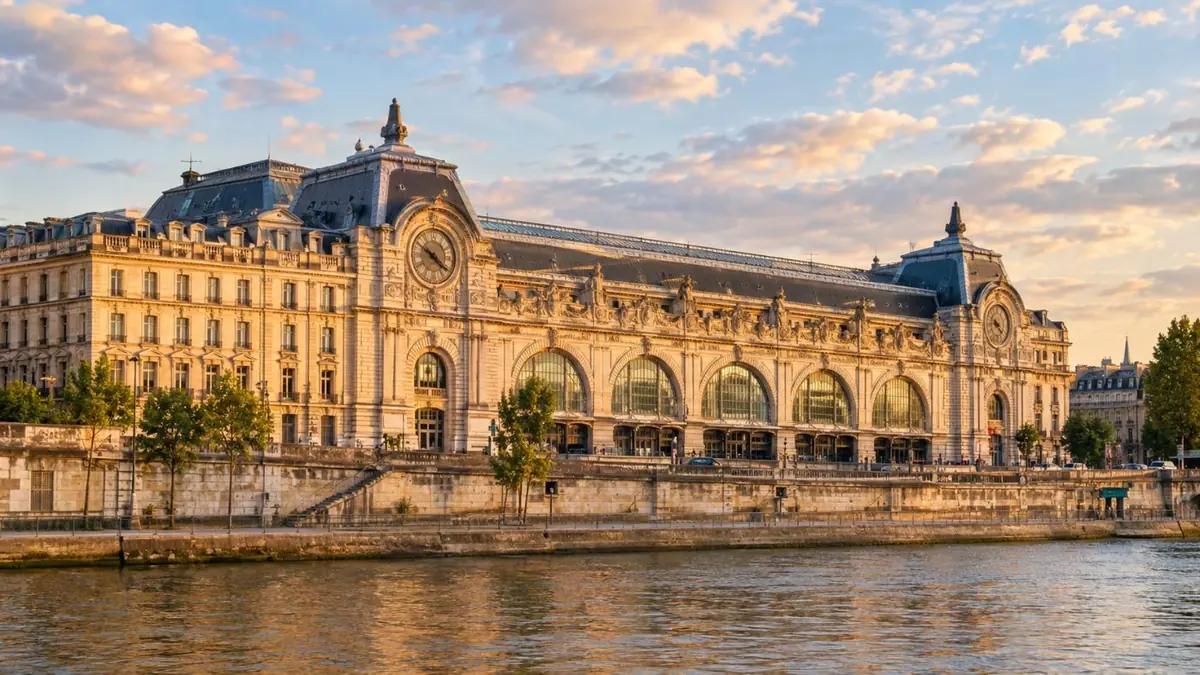
The house on rue Catherine-de-La-Rochefoucauld preserves nearly 14,000 works, including Jupiter and Semele (1895), The Chimeras (1884), and the painted version of The Apparition. The paintings the public knows from books are elsewhere: Oedipus and the Sphinx (1864) at the Metropolitan Museum in New York, Orpheus (1865), Galatea, and Jason at the Musée d’Orsay, Salome Dancing before Herod (1876) at the Hammer Museum in Los Angeles. A guided tour of Orsay in the afternoon complements the morning visit to the house well. The full itinerary is described on the works to see at the museum.
His drawings and paintings regularly appear at auction, with significant price variations depending on size and technique. But the best way to get to know him remains the house, which is open every day except Tuesday.
Seeing Moreau at Orsay
The guided tours of Orsay pass by the major Symbolist canvases before the Impressionists. Here are the group tour availabilities.
Frequently asked questions
Is Gustave Moreau an Impressionist?
No. He was a contemporary of the Impressionists but painted myths and biblical subjects in a style associated with Symbolism. His large canvases are displayed at Orsay alongside theirs, as shown in the guided tours of Orsay.
Why is Gustave Moreau important?
For three reasons: he is one of the major figures of Symbolism, he trained Matisse, Rouault, and several future Fauvists, and he created his own museum, bequeathed to the state with nearly 14,000 works. The details are on the museum history page.
What is Gustave Moreau’s most famous work?
Most likely The Apparition, made famous by Huysmans, and Oedipus and the Sphinx (1864), held in New York. The list of works to see at the museum distinguishes between what is on rue Catherine-de-La-Rochefoucauld and what is elsewhere.
Where did Gustave Moreau die?
In Paris, on 18 April 1898, in the house on rue de La Rochefoucauld where he had lived since 1852 and which he had already turned into a museum.
Who was Matisse’s teacher?
Gustave Moreau, head of the studio at the École des Beaux-Arts from 1892. Matisse, Rouault, Marquet, Manguin, and Camoin were among his 125 students. See the page Moreau’s students.